
Learn · Article
Run a Bot Organization — Don't Just Prompt Harder
Name the seats. Add a verify pass. Stop retyping the same ask.
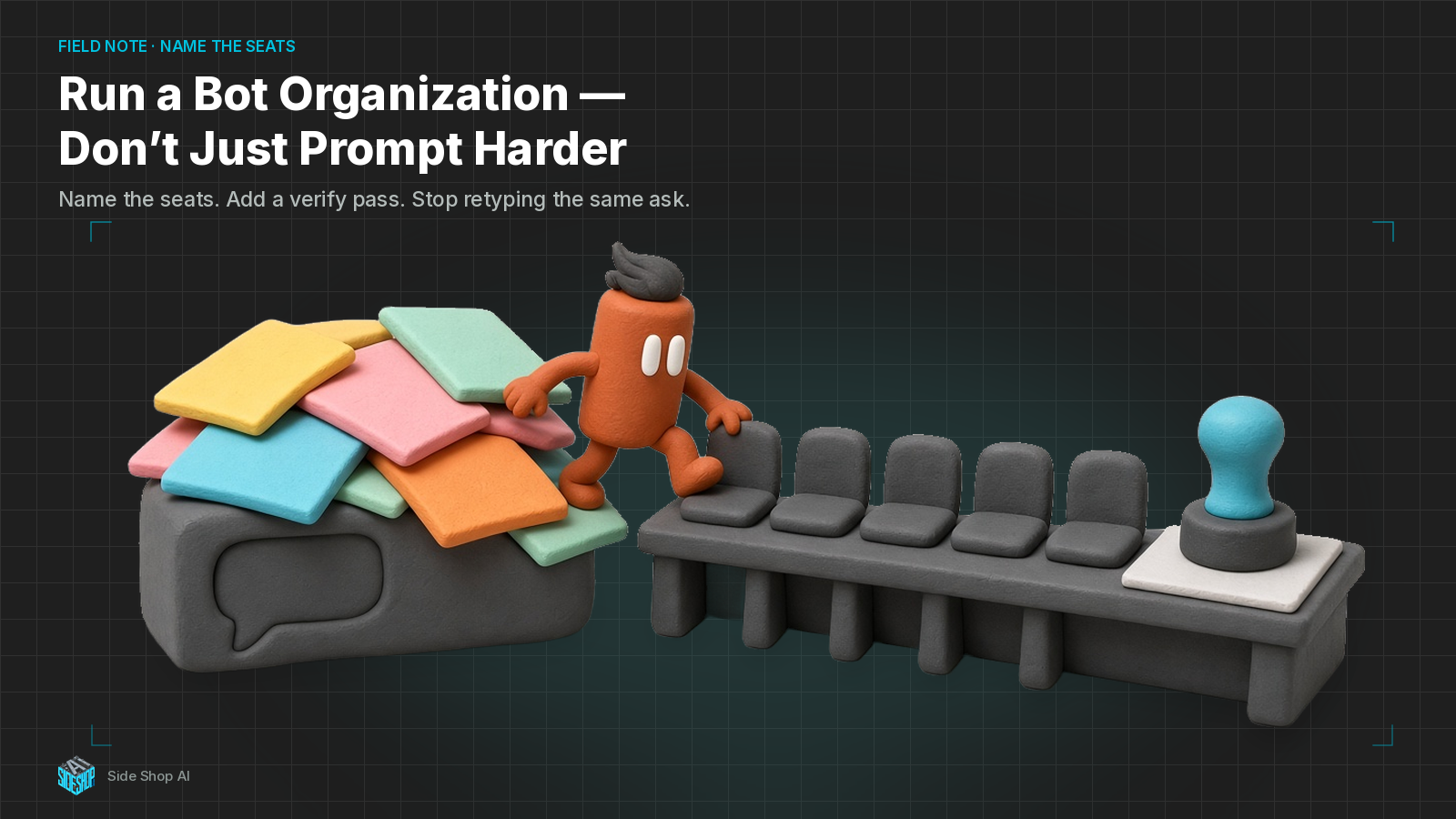
You ask again. Louder this time.
Same chat. Same pile. A clearer ask, a longer list, one more “think carefully.” The answer comes back tidy. It still skips a source. It still softens a number. It still leaves one claim unchecked. You retype. You feel thorough.
Tomorrow you are still prompting harder.
People assume a better answer comes from a better sentence. Sometimes it does. More often the chat is doing five jobs at once — own the ask, dig, draft, challenge, check — and none of those jobs has a clear owner. You keep polishing the prompt. The seats stay empty.
Run a bot organization. Don’t just prompt harder.
Borrow the pattern from @0xRafy (https://x.com/0xRafy/status/2106890013392908720): instead of one overloaded helper, give the work five specialized seats under one accountable manager — break the work down, find and cite sources, build the deliverable, attack weak logic, then verify the claims. The checklist is named seats plus a verify pass. Not a longer prompt.
We already know the work often dies between seats — not because the helper is broken, but because nobody owned the next step. This is the desk version of that. Name who owns the ask, who digs, who drafts, who challenges, and who checks. Then stop accepting the draft until the check happens.
Prompting harder won’t work unless the seats are named
A sharper ask will keep training you to babysit unless someone in the chat is charged with finding a source, someone else with writing the draft, someone with poking holes, and someone with verifying the claims before you treat the answer as done.
If everything stays one blurry “be helpful,” the bot will draft first and hope. Research becomes a confident tone. Critique becomes a polite hedge. Verify never arrives. You get faster at rewriting the same ask. The chat never learns which seat was empty.
Small shops feel it when a quote, a parts list, and a “looks good” all come from one pass with no one checking the numbers. Solo operators feel it when the same thread invents a fact, softens a claim, and still asks for praise. Households feel it when the school-form helper writes a tidy paragraph and never opens the form that would prove it.
The fix is not a louder “try again.” One named chain of seats, with a verify pass at the end, beats twenty polished restarts.
Five seats, in shop English
You do not need a developer org chart. You need five clear jobs inside the work — even if one person (or one chat) wears more than one hat on a small day.
1. Who owns the ask.
Break the work into steps. Name what “done” looks like before anyone drafts. This is the orchestrator seat — not a title on a door. It is the person (or the turn) that refuses a vague pile and turns it into ordered work.
2. Who digs.
Find the source. Cite it. Open the sheet, the form, the prior note. Research is not a confident voice. It is a pointer to something real.
3. Who drafts.
Build the deliverable — the quote, the reply, the list, the plan. Builder work starts after the ask is clear and the sources are in view. It does not invent the missing fact to stay helpful.
4. Who challenges.
Attack weak logic on purpose. Where is the soft number? Where did the claim skip a cite? Critic is not meanness. It is the seat that refuses a tidy wrong answer.
5. Who checks.
Verify the claims before you accept the output. Open the source again. Match the total. Confirm the date. Verifier is the last seat, not a vibe. If this seat never runs, you are still prompting harder and hoping.
Same chat. Different jobs. One manager still accountable — you.
Worked example: the customer reply that “looks done”
Without seats
You need a reply to a customer who asked about price, timing, and whether the part is in stock. One ask into one chat. The bot writes a warm note. The price is close. The timing is a guess. Stock is “should be fine.” You tighten the tone. You send it. Later you learn the part was not on the shelf.
With seats named first
Same ask. First you name the seats for this run.
Who owns the ask: answer price, timing, and stock — only from this week’s sheet and the parts list; stop before send. Who digs: open this week’s price sheet and the stock list; cite both. Who drafts: write the reply from those two sources only. Who challenges: mark any line that invents timing or softens stock. Who checks: match the price and the stock line to the sheet before the draft is treated as ready.
You still read it. You still own the send. The difference is the chat had to dig, draft, challenge, and verify — not just sound finished.
Where this sits on the desk
This is not “hire a fleet and hope the org chart appears.” It is not a weekly meeting. It is not a paste-this-prompt dump.
It is a process for one piece of work. Name who owns the ask, who digs, who drafts, who challenges, who checks. Run the verify pass. If the seat on your desk is Grok Bot, you can ask one helper to wear those seats in order — or split them when the work already splits. Setup over spectacle. Process over a louder ask.
You still own the yes. A verified draft can be ready. A send still waits for you.
One line to keep
Run a bot organization. Don’t just prompt harder.
Name the seats. Add the verify pass. Then let the chat do the work inside that chain.
Do this for me
Copy this into your Grok Bot chat, then fill in your own details.
Who owns the ask: answer price, timing, and stock — only from this week’s sheet and the parts list; stop before send. Who digs: open this week’s price sheet and the stock list; cite both. Who drafts: write the reply from those two sources only. Who challenges: mark any line that invents timing or softens stock. Who checks: match the price and the stock line to the sheet before the draft is treated as ready.