
Learn · Article
How to Program a Bot — Start with the Job
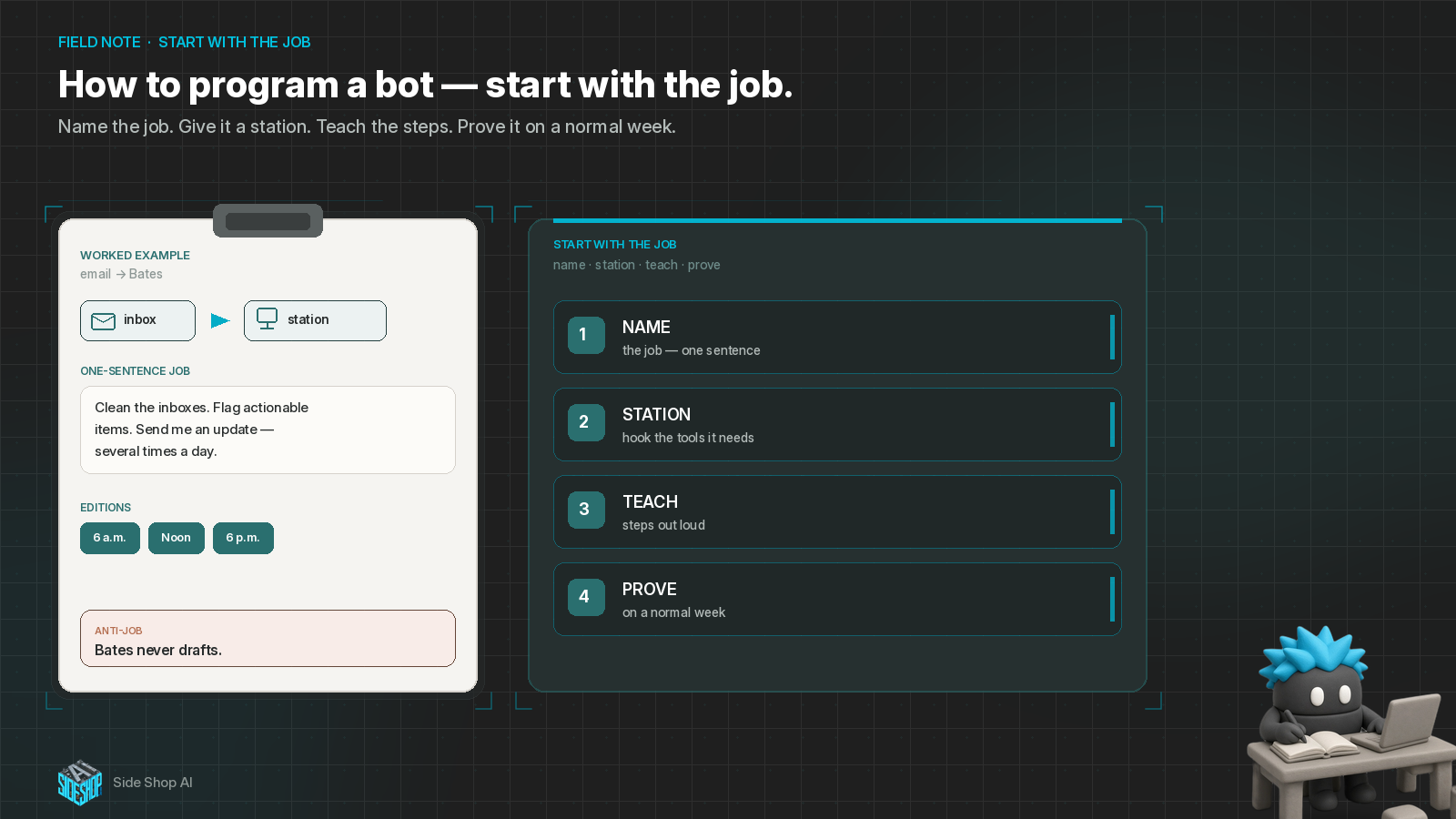
Name the job. Give it a station. Teach the steps. Prove it on a normal week.
Dinner for a full house. Dairy aware. A budget. Nobody wants a 45-minute debate every night over what’s for dinner.
That’s a real job. And that’s how you program a bot the Side Shop way: you start with the job, then build from there.
I’m not opening a chat and hoping. I’m naming a lane, giving it a station, teaching the steps, and proving it on a normal week.
This is for people running a household like a small shop. Parents. Military spouses. Anyone who’s also the planner, the shopper, the cook. Everyday folks feel this too — AI looks like noise until you point it at one concrete task you already hate. If you run a local service business, listen for the pattern. Same rules work when the job is phone intake instead of dinner.
How do we get better? Not “let’s get it right on the first try.” Week-one. Iterate. Prove it.
Rule 1: Name the job, not the tool
First rule is simple. Name the job, not the tool.
If you can’t say the job in one sentence, you’re not ready to set up help for it.
Yesterday we named one — *I Didn’t Hate Cooking — I Hated Deciding Dinner* (https://x.com/SideShopAi/status/2104969621178929207). That piece found the real hate and wrote the job sentence. This piece is what comes next: once you have that sentence, here’s how you program the bot.
Worked example: the email job
One sentence, okay:
I want my email inboxes cleaned out and an update sent to me on any actionable items.
That’s the job. Not “try ChatGPT on my inbox.” Not “add another email app.” The job is clean inboxes plus an actionable update I can read and review.
Give it a station
Now we give it a station. What tools does it need?
If I’m checking email, it has to hook up to my email. The station sits where the work already happens — not in a demo chat that never touches the real lane.
Write the job card
Here’s what we did. We wrote the job card: Purpose · Inputs · Outputs · Never.
It took some iteration. Started as just an email checker. Now we have something that informs — a named helper on a thin line.
I call him Bates. The name is flavor. The station is the work.
Thin stations on one line
Step two: split the line into thin stations.
We’ve got Email. We’ve got Calendar. We’ve got Packages. And then we’ve got where I want it to find News I’m looking to read.
Thin jobs. One lane each. Together they make a line you can teach out loud.
Teach the steps out loud
Step three: teach the steps out loud. That’s what we just did. We talked it out — purpose, inputs, outputs, never — until the station could repeat the work without guessing.
Stations where the work already happens
Step four: put the stations where the work already happens.
We know where Bates is pulling our information from. This is what he’s doing. He’s informing us. Not inventing a second inbox. Not opening a mystery tab. Informing — from the places the house already uses.
Anti-jobs are a check
And remember the anti-jobs.
Bates will never draft an email. That’s someone else. And that is a check.
The “never” line on the job card is not decoration. It’s how you keep a helper from growing into a job it wasn’t hired for. Informing is his seat. Drafting is another seat.
Prove it on a normal week
Now we’re going to use it for a week and see what happens. We’ll probably iterate a little. Change some times. Add some information.
I’m not checking all these places myself anymore. A report is being given to me proactively — all I have to do is read and review.
That’s the prove step. Same idea as *Don’t Trust the Charter. Trust the Failure Tests.* (https://x.com/SideShopAi/status/2103518668248215845): don’t leave a helper alone until the week looks boring. Soft prove. Human still owns the door.
Human in the loop every step
With whatever you’re doing, always keep a human in the loop.
Bates is pulling this information and giving it to me. Then I’m deciding what to do with it. Every step of the way.
He informs. I decide. Setup over spectacle.
Recap
Name the job. Give it a station. Teach the steps. Prove it.
That’s how you program a bot. Just ask the right questions.
Where Grok Bot fits
Week-one setup is not “open a chat and hope.”
It is: write the job in one sentence, give it a station with the right hookups, write Purpose / Inputs / Outputs / Never, split thin stations, teach the steps out loud, put the work where it already happens, lock the anti-jobs, then prove it on a normal week with you still in the loop.
Grok Bot allows you to decide what you need, and allows you to build it as you need it.
Your side shop for AI that actually helps the business run — and the household, too.