
Learn · Article
Your Bot Did Exactly What You Said, and Not What You Meant?
What eight years of therapy with my autistic son taught me about instructions: say the goal, say every step, and say what done looks like.
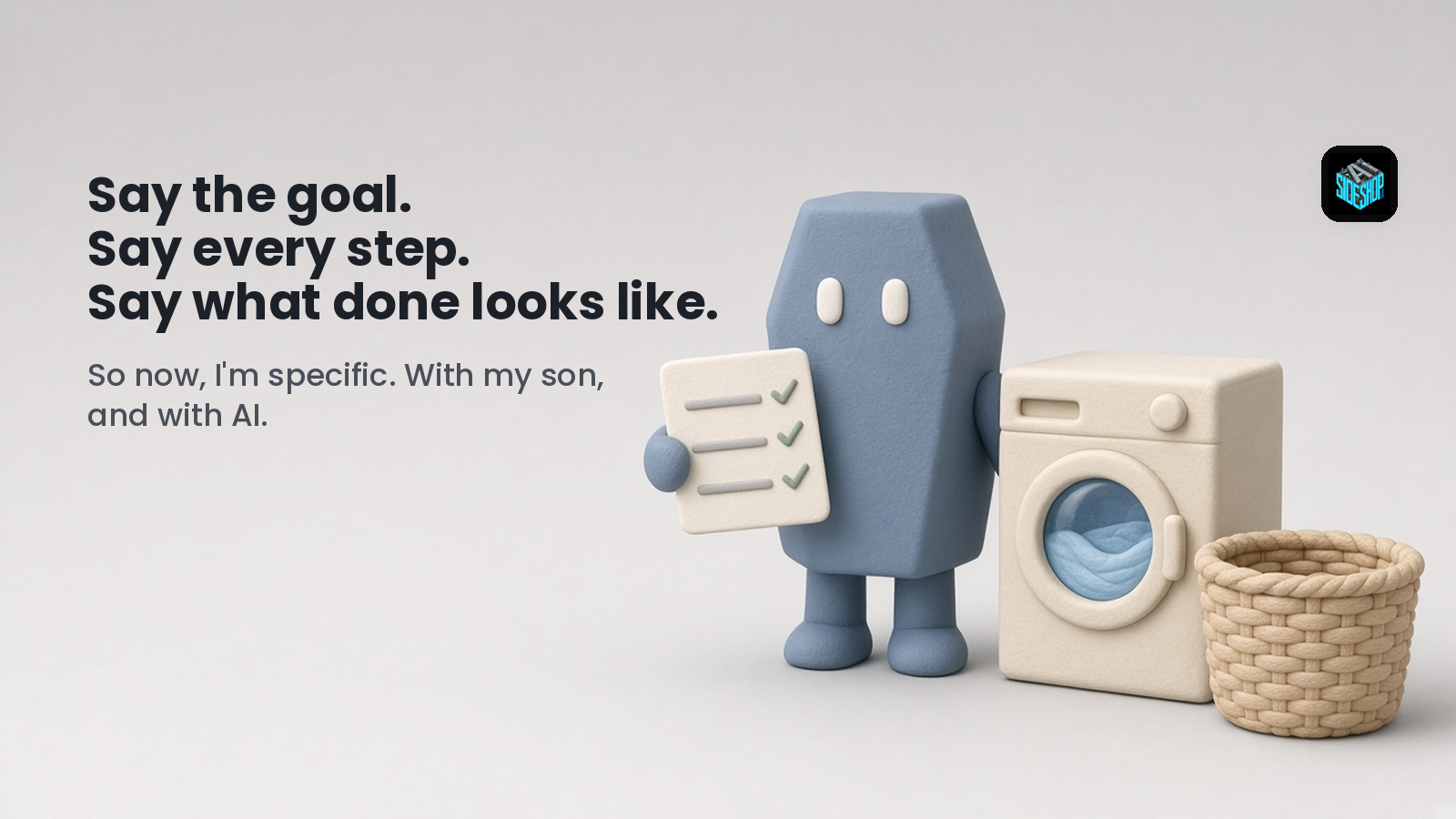
If I say to my son, "The washing machine is empty, please bring down your laundry," here's what happens. He gathers his mostly dirty laundry, brings it downstairs, and leaves it in the laundry room.
That's exactly what I asked for.
What I meant was: put your laundry in the washer, add detergent, add softener if you use it, and start it. That's why I mentioned the washing machine was empty. In my head, that detail carried the rest of the instruction. He didn't register the first part, and I didn't tell him to do those other steps.
My son is autistic. I've spent eight years in therapy with him. He's logical, and he thinks in black and white. When he was younger, he didn't understand nuance, sarcasm, implied instructions, or implied meaning. He did what the words said. Not what I hoped the words would suggest.
That isn't a flaw in him. Doing exactly what was asked is a strength. The gap was in my instruction. The way I see it: "Diagnoses do not determine character."
So now, I'm specific.
That habit is what helps me talk to AI.
Say the goal. Say every step. Say what done looks like.
How I give an instruction now
1. Say the goal. One sentence about what you actually want at the end, not a hint pointing toward it.
2. List every step. Even the ones that feel too obvious to say. Those are the ones that get skipped.
3. Say what done looks like. What should be in front of you when it's finished?
4. Don't rely on hints. If a detail is supposed to mean "and then do this," say "and then do this."
5. Check the result, and add the missing step. When something comes back half-finished, find the step you left out and put it in the instruction for next time.
Bots read the words, too
A helper running on advanced intelligence is very capable. It can draft, sort, compare, and summarize faster than I can. But it doesn't live in your head. Leave out a step because it feels obvious to you, and you'll often get back exactly what you asked for, and not what you meant.
That's the laundry room all over again. The bot did the part you said. The part you only implied never happened.
The easy reaction is to decide the bot isn't smart enough. Before you do, look at what you actually said.
Before and after
Here's a household example that works like the laundry instruction.
Before: "We're running low on groceries. Make me a list."
That's "the washing machine is empty." It hints that you want to shop for this week's dinners, but it never says so. What usually comes back is a reasonable list of staples: milk, bread, eggs, some produce. Half of it you already have. None of it is tied to what you're cooking.
After:
"Goal: one grocery list I can shop from on Saturday morning.
Steps:
1. Use this week's dinner plan, pasted below.
2. List every ingredient those dinners need.
3. Remove anything on my pantry list, also below.
4. Group what's left by section: produce, meat, dairy, everything else.
Done looks like: one list, grouped by section, with nothing on it I already own."
Same helper. Same job. The second version has everything it needs to come back as the list you wanted, because it finally says what you want.
It works the same in a shop. "The supply shelf is getting low" is a hint. "From the shelf count below, list every item under its reorder number, with the supplier and the usual quantity, in one table I can order from" is an instruction.
Why the hint fails
A hint only works if the other person fills in the same blanks you would. My son didn't, and he wasn't wrong not to. A bot often won't either. It wasn't there when you decided what "low on groceries" means in your house.
The fix isn't longer instructions for the sake of it. It's saying out loud the part you were counting on someone else to guess.
When it comes back wrong
Don't start over. Ask one question: what step did I leave in my head? Add that step to the instruction and save it. Next time, the same request has what it needs.
That's what I learned at home. When the laundry sat in the laundry room, the missing piece was in my sentence.
If you're new to Grok Bot
This is a good habit to start with on day one. Pick one small job you'd normally hand off with a single sentence, like a grocery list, a supply check, or a weekly reminder. Write the goal, the steps, and what done looks like. Then compare what comes back to what you meant, and add the step you forgot.
You don't need special words for this. You need to say the whole thing.
Eight years taught me that. The washing machine is empty. Please put your laundry in, add detergent, and start it.