
Learn · Article
Correcting Your Bot Is Not Teaching It.
A chat fix this turn isn’t a lasting rule — until it lands in the right home.
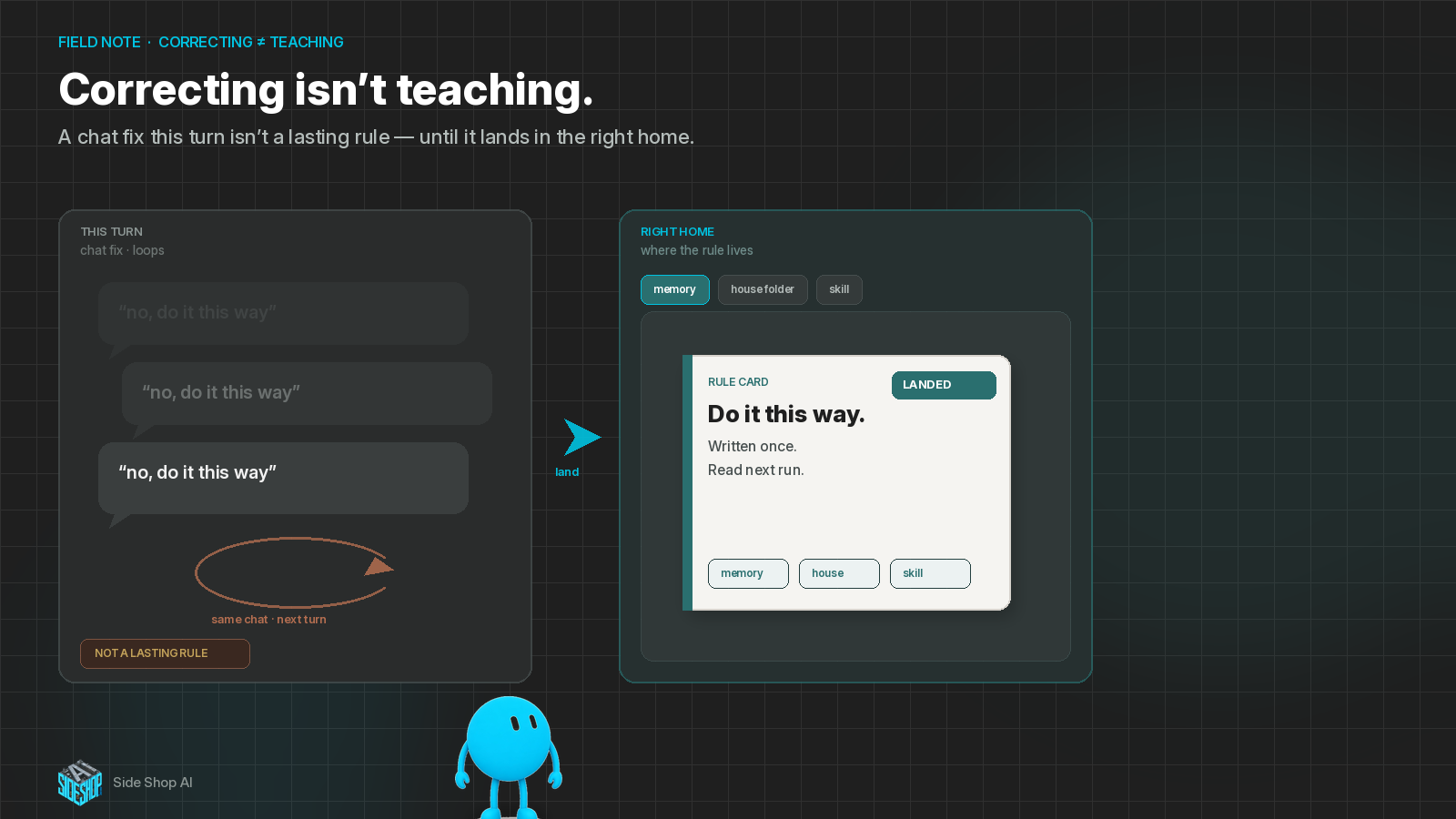
If you already run more than one helper, you know this busywork.
You corrected the tone last Tuesday. You corrected the refund window on Thursday. This morning the same bot makes the same mistake — calm, polite, and wrong in the familiar way.
Nothing wild happened. You fixed *this* chat. You never taught the house.
Correcting your bot is not teaching it.
That is a process failure, not a model failure. Borrow the pattern from @Michael_Fenech_ (https://x.com/Michael_Fenech_/status/2104662176661180776): a chat correction fixes this turn. It does not automatically become the lasting rule in the right home — memory, profile, routines, skills, or another seat. You can “correct” the same mistake for a week and still watch it come back. Teaching starts when the next run actually reads the rule where it lives.
Earlier we talked about seams between seats — *Your Bots Aren’t Broken. Your Handoffs Are.* (https://x.com/SideShopAi/status/2103156056306209089). A correction that never leaves the open chat is a broken handoff: nobody owns the lasting rule, and “done” means “I said something once.” This piece is the teaching side of that seam.
Why the same fix comes back
If you run a small shop, you feel it when the inbox helper keeps inventing a refund number you already corrected in chat. If you’re flying solo, you feel it when the writer bot reverts to long paragraphs after you asked for short ones three times. At home, you feel it when a helper “agrees” about bedtime and still uses last year’s version tomorrow.
You re-explain. They take the note. Next Tuesday the contradiction is back — because the truth lived in whichever chat was open last. The correction never graduated into a home the next run would open first.
Re-correcting feels like teaching. It feels busy and responsible. In practice it trains *you* to babysit, and it quietly burns the meter on the same argument. Iteration still costs usage even when the “iteration” is you repeating yourself.
The fix is an audit, not a louder scold.
Run a correction audit
Treat repeats as a signal that a rule is homeless — or living in the wrong drawer:
1. List the corrections.
Pull the last week of “no, do it this way” notes from chat. Plain bullets. No theater.
2. Group them.
Tone. Money rules. Who may send. Naming. Timing. Same pile, same problem.
3. Find the repeats.
Anything you corrected more than once is not a one-off mood. It is a missing lasting rule — or a stale one still winning.
4. Check every rules home.
Profile / description. Shared house folder. That bot’s memory. Skills. Routines. Sister seats that still hold an old version. If you only looked in chat memory, you did not finish the search.
5. Propose the smallest replace set.
One hard rule in the house pack. One shared fact in the house folder. One role preference in that bot’s memory. One Skill for the method. Do not dump everything into one giant note.
6. Approve topic-by-topic.
You press yes on money rules separate from tone. Smallest change that stops the repeat — then stop.
7. Write once. Delete stale.
Put the new rule where the next run will read it. Remove the outdated chat memory, old screenshot, or conflicting note so the wrong version cannot win tomorrow.
Same bots. Different teaching.
Everyday example: the refund correction
Correcting only
You tell the inbox helper in chat: “Refunds are thirty days, not fourteen.” It apologizes and drafts correctly — for this ticket. Next week a different thread invents fourteen again. You never wrote the shared house fact. You never updated the description line that says “never invent the window — look it up.” You taught the moment. You did not teach the desk.
Teaching
You run the audit. The repeat is the refund window. You check homes: chat memory has two versions; the house folder has none; the research bot still holds fourteen from last month. Smallest replace set: hard rule in descriptions (“refund window = house fact; never invent”), shared fact `refund-window-days: 30` with a dated note, delete the stale fourteen from specialist memory. You approve that topic once. Next run reads the house file first.
Same correction text. Different home. Only one of those is teaching.
Sister habits that sit next to this
Handoffs need a clear owner and a defined “done.” Lasting rules need the same — or the receiving seat invents policy mid-pass from whichever chat correction it remembers.
And if you keep paying to re-argue the same preference, remember the held sister idea: iteration eats usage. Re-correcting is try-again tax with a friendly face. Write the rule once in the right home so you are not metering the same argument every Tuesday.
Where Grok Bot fits
Week-one setup is not “argue politely in chat until it sticks.”
It is: notice the repeats, audit the homes, approve the smallest replace set, write once, delete stale. Grok Bot is a solid home for that map — named helpers with clear descriptions, shared computer files for house facts, memory for specialist taste, Skills for methods, Routines for clocks you already trust. Soft start when it fits: get on Grok Bot from about $20/mo (confirm live plan pricing before you treat that number as fixed).
Setup over spectacle. Correct the turn when you must. Teach the house when it repeats.
Imitate the audit. Iterate until repeats point at a missing home, not a “dumb model.” Innovate only after every seat knows where the lasting rule lives.
One line to keep
Correcting your bot is not teaching it.
That’s the bug. A chat fix this turn is not a lasting rule until it lands where the next run will actually read it. Audit the homes. Write once. Delete stale.
Your side shop for AI that actually helps the business run.