Learn · Article
Capability Is Not Permission
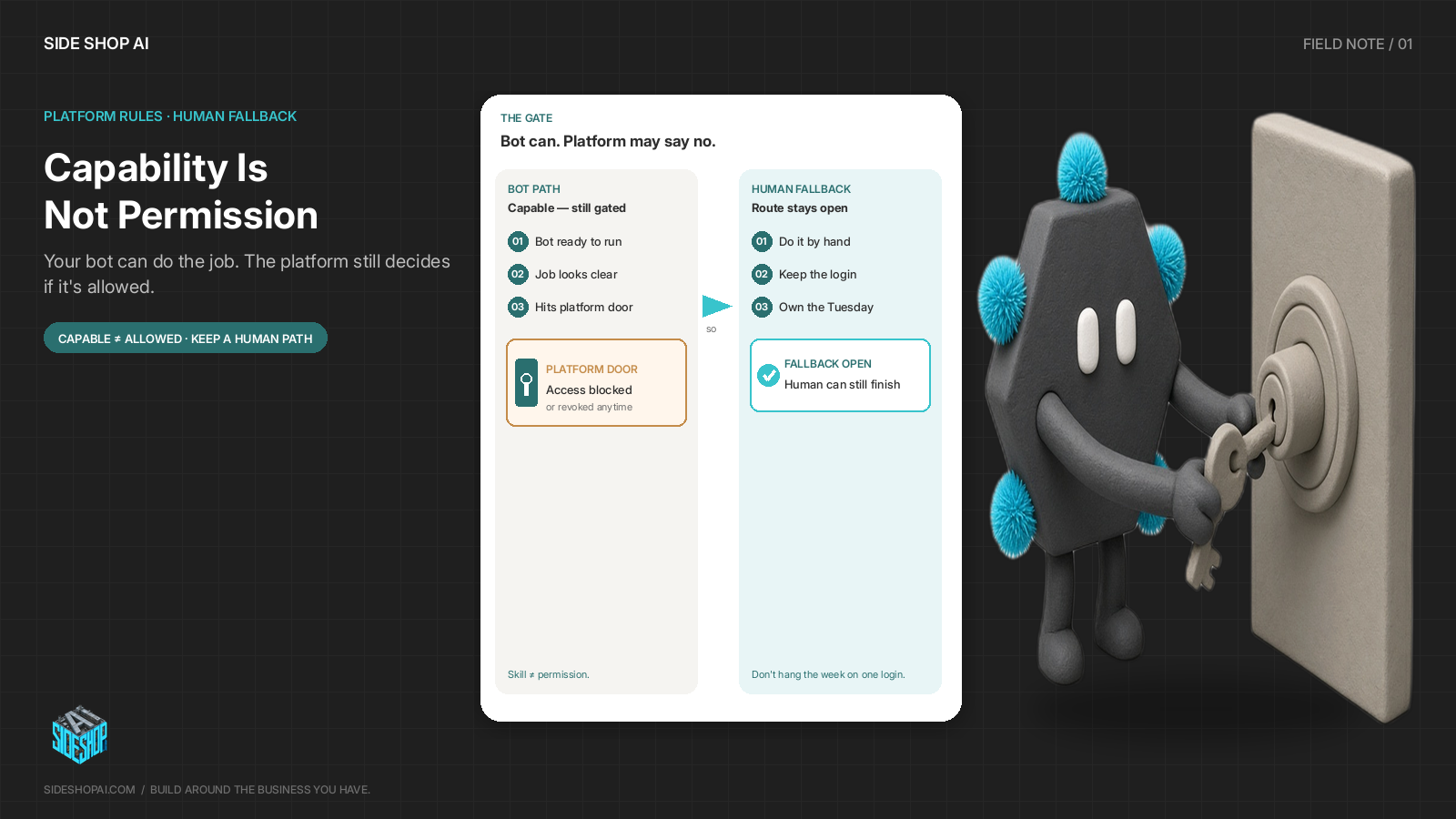
Your bot can do the job. The platform still decides if it’s allowed.
Your bot can do more every month.
That is not the same as being *allowed* to do it.
Amazon cutting off Muse is a useful warning for anyone whose assistant depends on platforms it does not control. The story is circulating hard — including in a clear checklist from @Michael_Fenech_ (source). You do not need the drama. Steal the question set.
Today an assistant can log in, browse, buy, research, or operate through someone else’s UI. Tomorrow that platform can change the rules, lock the door, or decide “bots” are not welcome on that path anymore.
Capability and permission are not the same thing.
Your assistant may be able to do the job. The platform still decides whether it’s allowed to.
The new single point of failure
For a small shop or an everyday setup, the fragile pattern looks ordinary:
- The bot “is” your email follow-up because it lives inside that inbox UI
- The bot “is” your shopping or supplier check because it clicks through that site
- The bot “is” your social or SaaS routine because it drives the web app like a person
It works — until access disappears. Then the Tuesday job that felt automated is just… gone. No glamorous outage. Just a blocked login and a pile of work you already stopped doing by hand.
Five questions before mission-critical
Before you hang an important workflow on someone else’s login or UI, ask:
1. Which tasks depend on third-party platform access? Name them in plain English.
2. What happens if that access disappears tomorrow? Who does the job, and how long does it take?
3. Can the workflow fall back to another route? Manual path, export, email, a second tool — something you can still run.
4. Is there a native API or integration you should use instead? Prefer the door the platform actually offers over a brittle UI walk.
5. Which agent workflows are critical enough to need redundancy? If losing it hurts cash, customers, or compliance, it needs a spare path.
If you cannot answer those five, you do not have a process yet. You have a dependency wearing a productivity costume.
Good pattern vs fragile pattern
Fragile: one bot path through one website login is the only way the job gets done. No export. No human checklist. No second route.
Sturdier: the assistant drafts, sorts, and prepares from *your* files and notes; anything that leaves through a third-party UI has a human at the exit — and a written fallback if that UI goes dark. Prefer official connectors and APIs when the job is real. Keep a boring manual path for the week the permission vanishes.
That pairs with draft-first and human-exit thinking without replacing it. Draft-first says nothing sends without you. This piece adds: nothing mission-critical should live only on a platform you do not control.
Where Grok Bot fits
Everyday Grok Bot use is not “operate everywhere.”
It is: onboard one real lane you own — notes, drafts, checklists, research from sources you keep — and treat third-party UIs as optional doors with backups, not as the foundation of the shop. Setup over spectacle. Permission is part of the setup.
Imitate the warning. Iterate until *your* critical jobs have a fallback. Innovate only after the boring path still works when a platform says no.
One line to steal
Your bot can do the job.
The platform still decides if it’s allowed.
Capability is not permission. Name the dependencies. Build the fallback. Prefer the official door. Keep a human exit.
Your side shop for AI that actually helps the business run.